Fleet Washing in Little Rock, AR
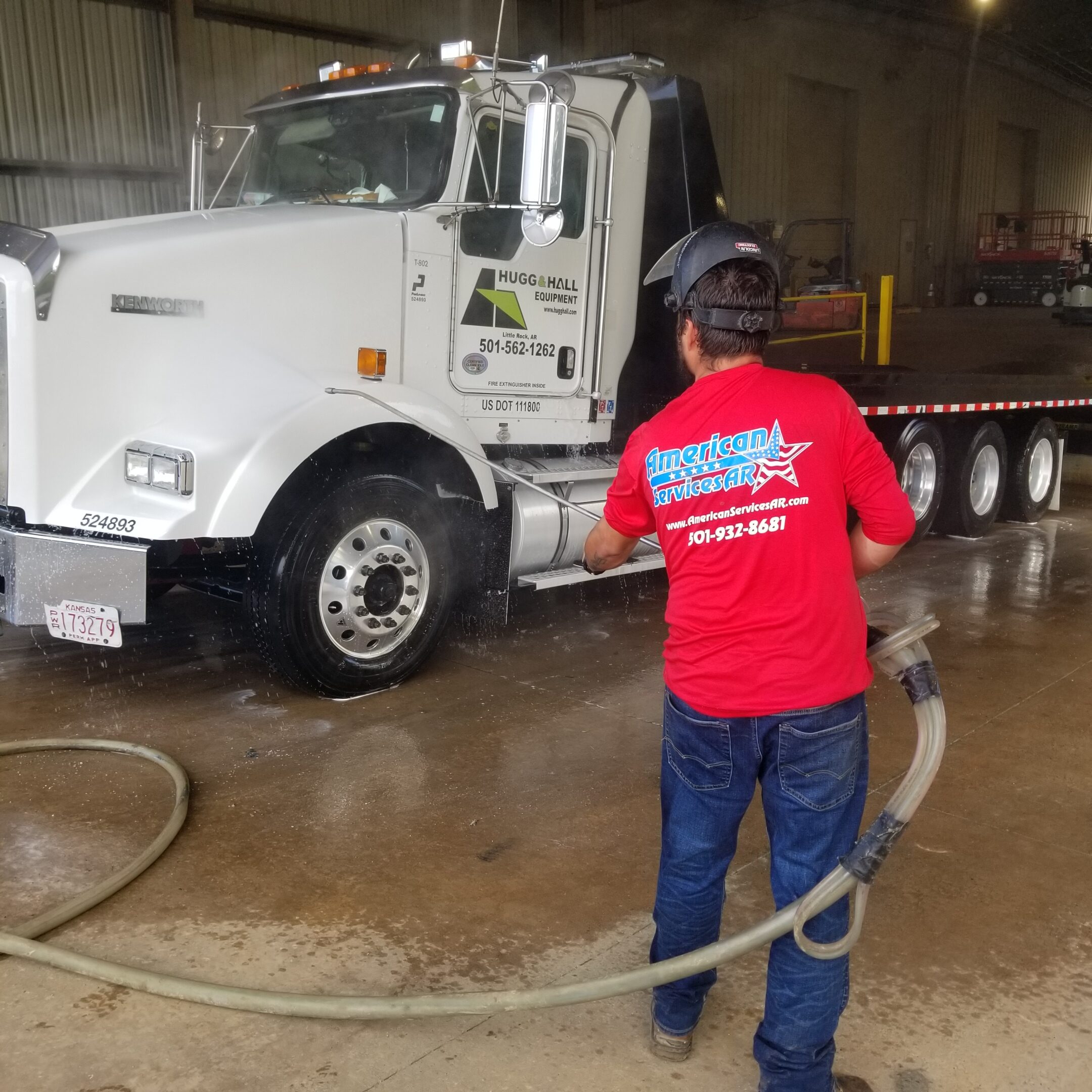
104 fleet washing jobs in Little Rock makes this our single busiest service in our single busiest city. It is also the most varied fleet work we do, because Little Rock holds the widest range of commercial vehicles in the state — tractor units and trailers moving through the interstate junctions, box trucks and delivery vans on metro routes, municipal and utility fleets, contractor and service bodies, and a large population of liveried vehicles whose entire purpose is to be looked at.
That variety is the whole problem. A fleet washing program that treats a sprinter van and a tandem dump the same way will either underclean one or overcharge for the other, and it will eventually damage something. So the first thing we do on a Little Rock fleet is stop treating it as one fleet.
Segmenting a Mixed Fleet Before Pricing It
We split a customer’s vehicles into groups that share a method, a frequency and a price, rather than quoting a flat per-unit rate that averages everyone into the wrong number:
- Brand-facing units. Wrapped or liveried vans and box trucks that park in front of customers. Washed more often, washed touchless, and judged on appearance rather than on whether the soil is technically gone.
- Line-haul tractors and trailers. High mileage, heavy road film, aluminum to protect, and a standard driven by how the unit presents at a receiver’s gate.
- Service and utility bodies. Compartment doors, ladder racks, bed liners and a great deal of awkward geometry. Slower per unit than anything else and priced accordingly.
- Heavy and off-road. Site mud, aggregate and asphalt. A different chemistry and a different expectation — the goal is removing what damages the machine, not making it look showroom.
- Light vehicles and pool cars. Quick, frequent, and usually the group where a sensible frequency saves the most money.
Road Film, and Why Pressure Alone Never Removes It
Every commercial vehicle in this metro carries road film — a bonded layer of diesel soot, brake dust, tire rubber and road oil that has been baked on by exhaust and sun. It is chemically stable and it is hydrophobic, which is why water runs off it and why a high-pressure rinse just polishes it. Turning the pressure up does not fix this; it only starts removing decals and forcing water past seals.
The fix is chemistry and dwell. A low-pH step breaks the mineral and metallic component, a high-pH step lifts the oils and carbon, and the sequence is rinsed under controlled pressure that carries soil away rather than driving it into a panel gap. On painted and wrapped surfaces this is deliberately touchless, so nothing abrasive is ever moved across the finish.
Modern Trucks Are Full of Things You Should Not Point a Lance At
This has changed materially in the last decade and a lot of washing practice has not caught up. A current commercial vehicle carries forward-facing radar behind or below the grille, a camera at the top of the windscreen, often side and rear cameras, lane-departure and collision-mitigation sensors, tire pressure sensors, and telematics and ELD hardware inside the cab with cabling that runs where you would not expect.
Close-range high pressure on a radar housing, a camera lens seal or a sensor connector is how a fleet ends up with fault codes after a wash and no obvious cause. We keep distance and angle off sensor locations deliberately, clean camera lenses by hand rather than by lance, and treat anything we do not recognize as something to leave alone and ask about. It is a small discipline that avoids an expensive and very hard-to-diagnose argument.
Washing With an Inspection in Mind
A clean vehicle does not pass an inspection on its own, but a dirty one makes several things harder than they need to be. Lamps, reflectors and conspicuity tape have to be visible and effective — a film of road grime measurably reduces reflectivity, and a coated lamp lens throws less light. Plates have to be legible. Fluid leaks have to be findable, and on a uniformly gray chassis they are not.
So on fleets where inspection performance matters, we wash to a slightly different specification: lamps, reflective tape, plates and mirror glass get particular attention, the chassis and the area around known leak points gets cleaned enough to read, and we flag anything we noticed. We are a washing contractor and not a DOT inspector, and we are careful about that line — but the person washing every vehicle every month is the person best placed to say “we saw fluid on the inside of the near-side rear wheel on unit 14”.
Glass, Mirrors and the Safety Argument
Windscreen and mirror clarity is the least glamorous part of a fleet wash and the one with the clearest safety return. Road film on glass is nearly invisible in flat daylight and then scatters badly at night and in low sun, which in this metro means the evening westbound run into the sun on the interstate. Mirror glass is worse, because it is small, it is angled upward into spray, and nobody cleans it at a fuel stop. We do glass and mirrors by hand on every unit, every visit.
Scheduling Across a Metro That Is Never Empty
Little Rock fleets rarely have a moment when every unit is parked, and the yards are spread across a large area. We work to that rather than against it: washing in the overnight window, at weekends, or in waves where a portion of the fleet is done per visit on a rotation, so the whole fleet gets covered on cycle without any vehicle being off the road for it. Little Rock is 28.9 miles from our yard, roughly a half-hour run, which makes a pre-dawn start on a metro yard a normal working arrangement rather than a special request.
Where a customer has sites on both sides of the river, we generally run them together — North Little Rock is a mile away across the bridge, and it is usually cheaper for everyone to treat the pair as one visit than as two mobilizations.
Fleet Washing in Little Rock, AR — Questions We Get
We have 6 vans, not 60. Is that too small?
No. A six-van liveried fleet on a monthly cycle is a perfectly normal arrangement for us and it is one of the better returns in this trade — those vehicles are seen by your customers constantly. The economics work because we are already in Little Rock on other yards; the mobilization is shared rather than charged to you alone.
Will pressure washing lift our wrap?
Not the way we do it. Wrap failure from washing comes from three things: pressure held too close, hot water on a seam, and brushing along a terminated edge. Touchless chemical washing at distance avoids all three, which is exactly why it is our default on liveried vehicles. If a wrap edge is already lifting before we arrive we will point it out rather than finish the job for it.
Do you do undercarriage and chassis?
Yes, and on anything that has seen a winter it is the part that matters most, because that is where de-icing chemistry sits and keeps working on frame, air lines and brake hardware. It is a separate line on the quote because it takes meaningfully longer and needs different access.
What do you need from our site?
Somewhere the vehicles can stand, a route the wash water is permitted to take, and access at the time we have agreed. We can bring water and power. What we need from you in advance is any environmental procedure or discharge condition that applies to the site — we would much rather work to your document than assume.
Can you handle multiple locations?
Yes, and we would generally recommend putting them on one schedule. Most of our larger Little Rock customers have more than one yard, and running them as a route rather than as separate bookings takes cost out for both sides.
What does it cost per truck?
It depends on the class, the condition and the frequency — and the first wash on a fleet that has not been touched in a year is always the expensive one, after which the cycle price settles. Our pricing guidance is above. For a mixed fleet we will walk the yard, count by class and give you a per-unit rate for each group rather than one averaged number that is wrong for every vehicle in it.
★ 4.9 Google Rating | Since 2010 | Fully Insured | Free Estimates
When your property needs professional fleet washing Little Rock AR service, American Services AR delivers — the capital and largest city in Arkansas with diverse residential and commercial properties. We provide expert fleet washing Little Rock AR homeowners and businesses rely on, with fully insured service and free estimates throughout Pulaski County. Call (501) 289-5623 to schedule your free estimate today.
Fleet Washing Little Rock AR — Pricing Guide
Pricing for fleet washing Little Rock AR depends on property size, surfaces, and scope of work:
- Standard commercial vehicle (van or truck): approximately $40 to $80
- Semi truck (cab only): approximately $75 to $125
- Semi truck + trailer: approximately $120 to $200
- Volume fleet pricing: available for 5-plus vehicles per visit
We provide free, on-site estimates for every fleet washing Little Rock AR job throughout Pulaski County. No surprise charges — we quote the complete job before we begin. Call (501) 289-5623 or request a free estimate online. We respond the same business day.
Areas We Serve
American Services AR is based in Conway and has worked across Arkansas since 2010. These are the main markets our crews cover — each link opens that city’s page.
Central Arkansas
Across Arkansas
Related Services in Little Rock, AR
- Pressure Washing in Little Rock, AR
- Concrete Cleaning in Little Rock
- Solar Panel Cleaning in Little Rock
- Gutter Cleaning in Little Rock, AR
- De Icing in Little Rock
Where can I find fleet washing near me in Little Rock, AR?
American Services AR provides professional fleet washing near you throughout Little Rock, AR and Faulkner, Pulaski, Saline, and surrounding counties. We’re locally based in Conway — same-day and next-day appointments available. Call (501) 289-5623 or book online to schedule fleet washing near you today. Median property value in Little Rock is around $221,200, and we scope and price from the building in front of us either way.