
House Washing in Conway, AR
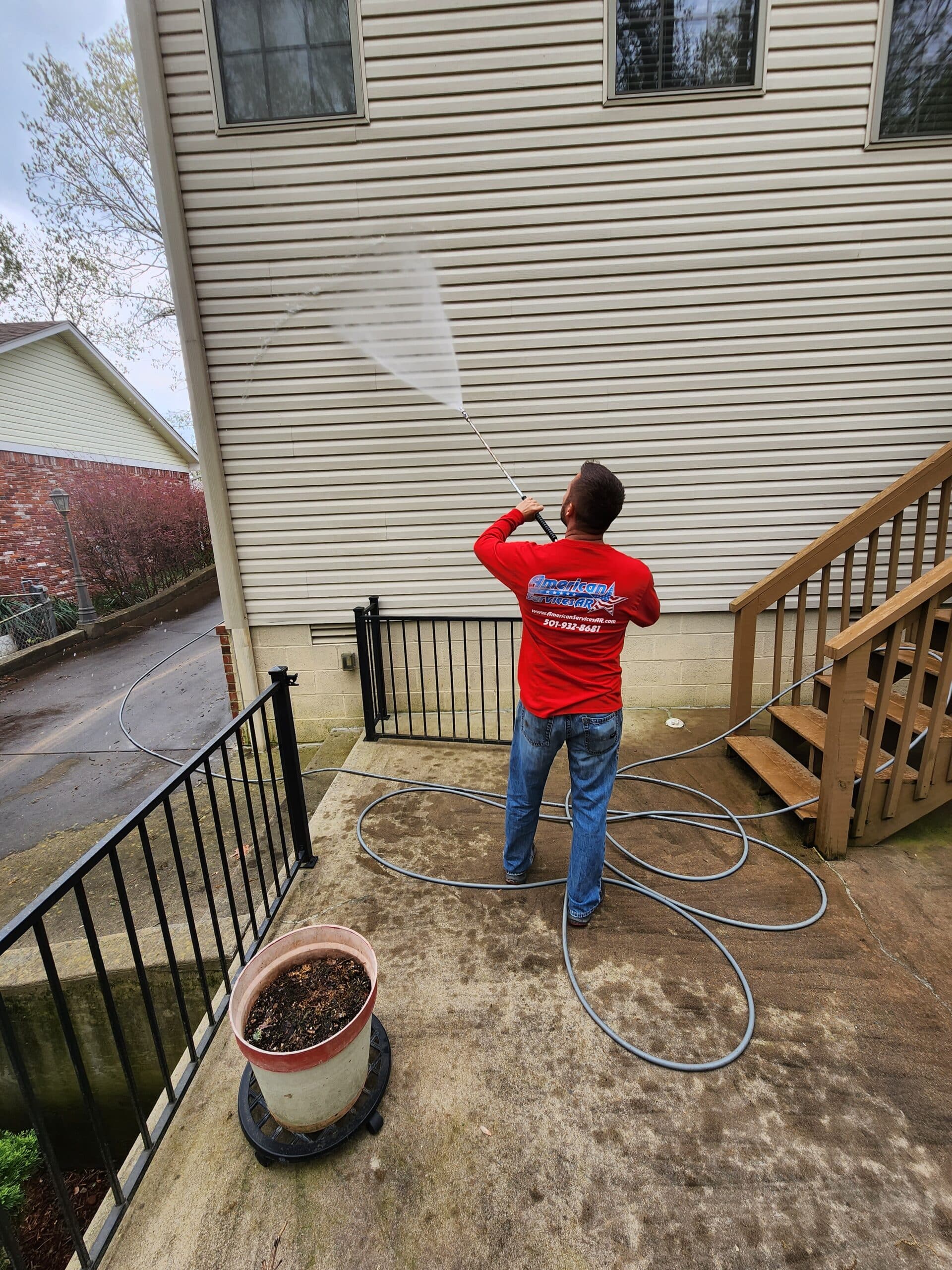
A house wash is a single, specific job: cleaning the exterior walls of your home — siding, brick, trim, soffit, fascia, gutters’ outer face, porch ceilings and the eaves. It is not the driveway, it is not the roof, and it is not a general pressure washing package. It is the thing that makes a house look cared-for from the street, and for most Conway properties it is a once-a-year job.
Our records show 14 house washing jobs in Conway within the 1,310 total here, and it is usually the service people book first because it is the one they can see from the driveway.
What Is Actually Growing on Your Walls
The green tint on the north side, the black speckling under the eaves, the general dullness that has crept up over three or four years — almost none of that is dirt. It is living growth, and that single fact determines the whole method.
- Algae. The green film, worst on north-facing and shaded elevations. It feeds on moisture and it thrives in Arkansas humidity.
- Mildew and mold. The black speckling, concentrated under eaves, behind downspouts and anywhere air does not move.
- Lichen. The crusty gray-green patches on brick and masonry. It has a root structure that goes into the surface, which is why scrubbing it off leaves a mark.
- Artillery fungus. Tiny black dots on siding, usually within a few feet of a hardwood-mulched bed. It fires spores upward and they cement themselves to vinyl. Genuinely difficult to remove and easier to prevent by changing the mulch.
- Pine sap and pollen — the Faulkner County addition, on anything under a tree.
Because it is biological, chemistry is what removes it and pressure is not. A cleaning solution with correct dwell time kills the organism at the root and the growth stays gone for a season or more. Blasting it off removes what you can see and leaves the root structure in the surface, which is why a pressure-washed wall darkens again within months.
Your Siding Decides the Method
The typical Conway home dates to around 1997, which usually means vinyl siding, brick, or a combination with vinyl-clad soffit and fascia.
Vinyl cleans beautifully with low pressure and the right solution. It has exactly one serious risk and it is the reason we never use a pressure lance on it: water forced upward under the laps gets behind the siding and into the sheathing, and you do not discover it for months, when there is a stain inside or a soft patch in the wall. Vinyl laps are designed to shed water running down, not water driven up.
Older vinyl can also be oxidized — chalky to the touch, faded. Cleaning removes the chalk and can leave the color looking uneven, because the chalk was masking the fade. We test a section and tell you what to expect rather than discovering it halfway along an elevation.
Brick is tolerant but not invincible. Modern Conway brick is hard-fired and takes moderate pressure; mortar joints are the weak point and high pressure cuts them out.
Painted trim, soffit and fascia get soft washing only. Pressure lifts paint at the weakest bond in the stack and you will not know which layer that is until it comes off.
How the Job Actually Runs
- Walk it with you. Identify every surface, find what is already damaged — failed caulk, lifting paint, soft trim, a cracked pane, a loose gutter — and photograph it. This protects both of us.
- Protect. Beds wet down and covered, windows closed and checked, light fittings and outlets covered, furniture moved off the porch.
- Apply bottom-up. This matters. Solution running down a dry wall leaves streaks that are harder to remove than the original soiling.
- Let it dwell. The chemistry needs time to work. A crew that applies and immediately rinses has not cleaned anything — this is the step that gets skipped when somebody is rushing.
- Rinse top-down at low pressure, thoroughly, including the windows the solution has run over.
- Rinse the surroundings. Beds, plants, walkways, the neighbor’s fence. Plants tolerate dilute solution followed by a proper rinse far better than solution left to dry on the leaves.
- Walk it with you before we pack up.
When to Have It Done
Annually suits most Conway homes. The shaded and north-facing elevations will always need it more often than the sunny side of the same building — that is where the growth lives, and it is not the wash failing.
Timing: after the spring pollen has finished, or in the fall. Washing during the pollen drop means a yellow film again within two weeks and it feels like money wasted. If you are selling, do it two weeks before photographs rather than the day before — the house looks better once everything has settled and dried fully.
House Washing in Conway, AR — Questions We Get
Will this damage my vinyl siding?
Not the way we do it, because vinyl does not get pressure. The damage people see comes from a lance held close, which forces water up under the laps and into the wall — vinyl sheds water running down, not water driven up. Soft washing cleans it better anyway, because the growth is biological and needs chemistry rather than force.
The green comes back every year. Is that normal?
On a shaded or north-facing elevation in Arkansas, yes — that is where algae lives and the humidity keeps it fed. Properly soft washed it stays gone for a season or more; a pressure-blasted wall comes back in months because the root structure was never killed. Annual washing on the shaded side is normal maintenance, not a sign of a poor job.
What are the little black dots that will not come off?
Almost certainly artillery fungus, which grows in hardwood mulch and fires spores onto the siding where they cement themselves on. It is one of the genuinely difficult things to remove and there is no method that reliably takes all of it off vinyl. The practical answer is prevention — switching the beds near the house away from hardwood mulch.
What about my plants?
Wet down before, covered where they are close to the wall, and rinsed thoroughly after. The rinse is the part that matters — plants handle dilute solution followed by water far better than solution left to dry on the leaves. Tell us about anything precious and we will work around it.
Do you do the roof at the same time?
It is a separate service and a separate price, but doing them together makes sense if the roof needs it — roof runoff carries growth down onto the walls, so cleaning the walls under a dirty roof shortens how long the result lasts. Roofs are soft washed only, never pressure.
How long does it take?
Most single-story Conway homes are a half day; a larger two-story is most of a day. Heavy growth, artillery fungus or a house that has not been washed in six years takes longer, and we would rather quote the honest figure than turn up and rush the dwell time, which is the step that actually does the cleaning.
★ 4.9 Google Rating | Since 2010 | Fully Insured | Free Estimates
When your property needs professional house washing Conway AR service, American Services AR delivers — home to the University of Central Arkansas and one of Arkansas’s fastest-growing cities. We provide expert house washing Conway AR homeowners and businesses rely on, with fully insured service and free estimates throughout Faulkner County. Call (501) 289-5623 to schedule your free estimate today.
House Washing Conway AR — Pricing Guide
Pricing for house washing Conway AR depends on property size, surfaces, and scope of work:
- Single-story house exterior: approximately $175 to $325
- Two-story house exterior: approximately $275 to $475
- Full exterior package (house + concrete): combination pricing available
- Commercial buildings: priced by square footage with free estimate
We provide free, on-site estimates for every house washing Conway AR job throughout Faulkner County. No surprise charges — we quote the complete job before we begin. Call (501) 289-5623 or request a free estimate online. We respond the same business day.
Areas We Serve
American Services AR is based in Conway and has worked across Arkansas since 2010. These are the main markets our crews cover — each link opens that city’s page.