Solar Panel Cleaning in Little Rock, AR
Little Rock is a harder city to run a solar array in than its latitude suggests, and the reason
is trees. The older neighborhoods have mature willow oak, water oak and hickory canopy directly
over the rooflines, and canopy does two separate things to an array: it drops material onto the
glass, and it shades cells. Those are different problems with different fixes, and it is worth
knowing which one is costing you output.
Soiling and Shading Are Not the Same Problem
Soiling is material on the glass. Pollen, dust, leaf litter, tree sap, bird
droppings. It reduces the light reaching the cells and it is fixed by cleaning.
Shading is a branch or a structure blocking light. Cleaning does nothing for
it. It is fixed by a tree service, and on a canopy-covered Hillcrest or Heights property it is
frequently the larger of the two effects.
Shading also behaves worse than people expect. A panel is a series circuit, so shading part of
a module does not reduce its output proportionally — it can drag down the whole string. An
array sized for the shading conditions of 2018 may be materially shaded by 2026, because the trees
kept growing. We will tell you which problem we think you have, and if it is shading we will say
so even though the fix is not a job we are selling.
Bird Droppings Cause Real Damage
Worth understanding because it changes how urgent a call is.
An even film of dust reduces output roughly in proportion to how much light it blocks. A
completely opaque spot such as a bird dropping does something different: the
shaded cell stops generating and instead resists the current the rest of the string is pushing
through it. That resistance becomes heat, and a localized hot spot can permanently damage the cell
and eventually the module.
Modern panels have bypass diodes that limit this, but they act at cell-string level rather than
per cell, so the protection is partial. Under heavy tree canopy where birds perch, this is a
recurring rather than occasional issue, and it is the main argument for a scheduled clean on a
wooded Little Rock property.
Purified Water, No Detergent, Never Hot
Deionised water through a soft brush. It dries without leaving mineral residue,
so there is no spotting and no squeegee required. Tap water is the opposite — Arkansas
groundwater carries dissolved minerals that dry into exactly the spotting you were trying to
remove, and over repeated cycles those bond into the glass and become a much harder
problem.
No detergents. Soap films attract soiling faster than clean glass does, and
some cleaners attack the anti-reflective coating on the panel surface, which is part of what makes
it efficient. Manufacturer warranties generally have something to say about this.
Never a hot panel. Cold water on glass that has been in Arkansas sun all
afternoon risks thermal shock. We work early morning or on overcast days, which is also when the
array is generating least so you lose the least production.
Never standing on the modules. Foot pressure causes micro-cracks in the cells
that do not look like damage and do show up as lost output and eventual failure. We work from the
roof around the array or from ladders and extension equipment.
Steep Pitches and Older Roofs
Two Little Rock complications worth raising before the visit.
Older properties here often have considerably steeper pitches than modern construction, and
hillside lots mean the roof edge can be two stories up on the downhill side. Array access on those
properties is planned rather than assumed, and sometimes the honest answer is that part of an array
can only be reached with equipment.
The second is roof condition. The median Little Rock home dates to 1978, and an
array is frequently mounted on a roof that is now well into its life. If we see failing shingle
around the mounts or anything that looks like water getting in, we will photograph it and tell you
— because a roof replacement under an existing array is a considerably bigger job than doing
it before the panels went on, and the earlier you know the better.
What Else We Check
- Debris packed under the array — leaf litter between panels and roof,
which holds moisture against the shingle. - Nesting. Birds and squirrels get into the gap under panels and chew wiring.
Critter guard along the array edge is inexpensive relative to the alternative. - New shading from growth since installation.
- Visible damage — cracked glass, delamination, discolored cells, burn
marks near a junction box — photographed and handed to you to raise with your
installer.
Solar Panel Cleaning in Little Rock, AR — Questions We Get
Our output has dropped. Is it dirt?
Possibly, and on a tree-covered Little Rock lot it is at least as likely to be
shading from growth since the array went in. Cleaning fixes soiling; only a tree service fixes
shading. We will tell you which we think it is after looking, including when the answer means you do
not need us.
Does rain not do the job?
Partially, and mostly on the upper part of a tilted panel. It does not shift
bonded sap, pollen or bird droppings, and it does nothing for the debris band that collects along
the lower frame edge. Under heavy canopy there is a constant supply of new material, so rain is
always behind.
One panel has a bird dropping on it.
That is worth dealing with sooner than general dust. An opaque spot stops that
cell generating while the string pushes current through it, and the resistance turns into heat that
can permanently damage the cell. Bypass diodes limit it but only partially. Under tree canopy where
birds perch it is a recurring issue rather than a one-off.
Can you reach our array? The roof is
steep.
Usually, with planning. Steep pitches and hillside lots are normal
here and access gets worked out before the visit rather than on the day. Occasionally part of an
array can only be reached with equipment, and we would rather tell you that at quoting than turn up
and improvise.
Why purified water rather than a
hose?
Because tap water leaves mineral spotting as it dries, and repeated
cycles bond those deposits into the glass. Deionised water dries clean with no residue and needs no
squeegee. It is also why we use no detergent — soap films attract soiling and some cleaners
damage the anti-reflective coating.
How often should we have it done?
Twice a year on most Little Rock arrays, and at the shorter end under mature
canopy where there is a continuous supply of litter and droppings. An array on an open roof with
good tilt sheds more naturally in rain and needs less.
American Services AR delivers professional solar panel cleaning in Little Rock, AR — restoring lost solar production for homeowners and businesses across Pulaski County using deionized water soft-wash methods that are safe for all panel brands and warranties.
Solar Panel Cleaning Prices in Little Rock, AR
- DI water soft wash
- Spot-free rinse
- Safety inspection
- Before/after photos
- DI water soft wash
- Spot-free rinse
- Safety inspection
- Before/after photos
- Efficiency report
- DI water soft wash
- Spot-free rinse
- Safety inspection
- Before/after photos
- Efficiency report
Book twice per year (March/April before cedar and oak pollen peak + October) and save 10% per visit. Book quarterly and save 20%. Little Rock’s dual pollen seasons make bi-annual cleaning essential for Chenal Valley homeowners.
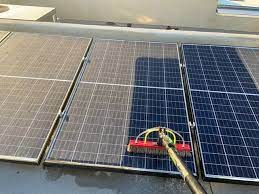
Before & After — Little Rock Solar Panel Cleaning
Areas We Serve
American Services AR is based in Conway and has worked across Arkansas since 2010. These are the main markets our crews cover — each link opens that city’s page.