Pressure Washing for Little Rock Homes
There is no single right way to wash a Little Rock house, and anyone who quotes you a per-square-foot rate over the phone is telling you they have not thought about it. The median home here dates to 1978, but across 99,697 housing units that median sits between 1890s Quapaw Quarter townhouses, 1920s Hillcrest bungalows, post-war Heights colonials, 1970s ranches through Midtown, and 2000s construction out past I-430.
Those are five different substrates and five different methods. What your house is made of, and roughly when it was built, decides everything about how it should be cleaned.
Your House’s Age Decides the Method
Pre-war: soft-fired brick, lime mortar, painted wood
The oldest housing here is the most rewarding to clean and the easiest to wreck. Soft-fired brick has a hard fired skin over a porous body; strip that skin with pressure and the brick starts absorbing water and spalling at the next freeze. Lime mortar washes straight out of the joint. Painted wood trim on these houses is frequently carrying a century of coatings, and the oldest layer is the weakest link — pressure finds it and takes everything above it off.
These houses get the lowest effective pressure, appropriate chemistry, and a test patch somewhere inconspicuous before anyone touches a main elevation. Occasionally the honest answer is that an elevation belongs to a masonry restoration specialist rather than to us.
Post-war through the 1970s: painted brick, board, early siding
The biggest slice of the city. Usually sound and tolerant, with two specific cautions. Painted brick and painted block from this era is often chalking — run a hand over it and it comes away powdery. Washing chalked paint takes the chalk and some color with it and leaves a patchy elevation that now needs repainting, so we test first and tell you what we expect. The other is that houses of this age may carry original cement-board or asbestos-containing siding, which is never to be aggressively cleaned or abraded; if we see it, we will say so and treat it gently.
1990s onward: vinyl, EIFS, composite
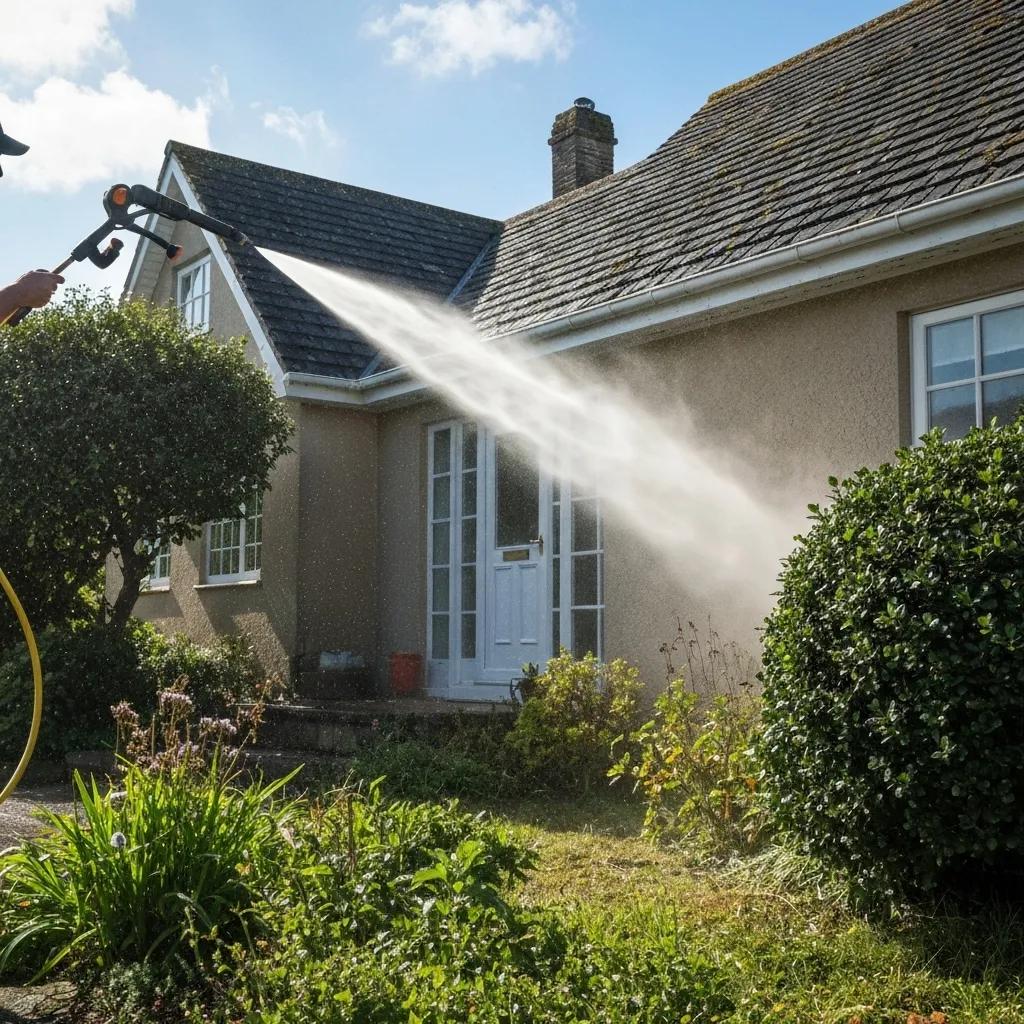
Straightforward and entirely soft-wash territory. Vinyl siding takes chemistry well and pressure badly — a lance held close forces water up under the laps and into the wall cavity, and the damage shows up months later as a stain or a soft spot. EIFS is more fragile still: a pressure lance cuts through the finish coat to the foam and that is a repair, not a clean.
Hillside Lots: Drives, Retaining Walls and Where the Water Goes
Little Rock has real topography and it changes this job more than people expect.
Sloped driveways mean the cleaning solution and the runoff travel, so sequencing matters: work the low end first and move up, or you spend the day chasing dirty water across the part you already finished. It also means everything downhill of the drive — beds, a lower patio, a neighbor’s property — needs planning for before the first trigger pull, not after.
Retaining walls are everywhere here and they are usually the dirtiest, greenest surface on the property because they are shaded, damp and against soil. They clean up dramatically. Segmental block walls need moderate pressure at most; mortared stone needs the same caution as any older masonry.
Steps and steep walks are the genuine slip-safety item on a hillside property. Algae on a sloped walk in the shade is the reason people fall, and it is the part of the job with the clearest return.
What Actually Grows on a Little Rock House
The green and black on your north elevation is biology, not dirt, and that is why pressure alone never fixes it. Arkansas humidity plus mature tree canopy in the older neighborhoods gives you algae on siding and masonry, mildew in shaded corners and under eaves, lichen on north-facing stone and roofs, and moss where water sits.
All of it has root structure in or on the substrate. Chemistry kills it and it stays gone for a season or more; pressure removes the visible top and leaves the roots, which is exactly why a blasted wall looks worse a year later than a soft-washed one. On heavily shaded Hillcrest and Heights properties, expect the shaded elevation to need attention roughly twice as often as the sunny side of the same house. That is not the wash failing.
The Order We Work In
- Walk it together and photograph the damage that is already there. Failed glazing putty, lifting paint, cracked render, rotten trim, a loose gutter. On older Little Rock houses there is nearly always something, and it needs to be on record before we start.
- Test patch on anything old, painted or masonry, and show you the result before committing to the elevation.
- Protect — plants wet down and covered, windows checked and closed, fittings covered, and anything downhill considered.
- House before flatwork, always, so runoff from the elevations does not land on clean concrete.
- Soft wash bottom-up, rinse top-down. Solution running down dry siding streaks, and streaks are harder to remove than what you started with.
- Flatwork with a surface cleaner, then rust and oil treated individually.
- Walk it with you at the end before anything is packed away.
Pressure Washing in Little Rock, AR — Questions We Get
You are in Conway. Do you really cover Little Rock?
Yes — 28.9 miles, about a half-hour, and Little Rock is one of our two busiest cities across every service we run. We schedule Little Rock residential work in blocks rather than one house at a time, so booking a week or two out gets you a better slot than calling on the day.
My house is from the 1920s. Is this safe?
With the right method, yes — and it starts with a test patch rather than a quote. Soft-fired brick, lime mortar and old paint all need the lowest effective pressure and correct chemistry. If an elevation is too fragile for us we will tell you and point you at a masonry specialist instead of taking the job and damaging the building.
What is the green stuff, and will it come back?
Algae, mildew and sometimes lichen. Properly soft washed it stays gone for a season or more. It comes back fastest on shaded, north-facing and tree-covered elevations, which in Hillcrest and the Heights is most of them — expect the shaded side to need doing about twice as often as the sunny side.
Can you do the retaining wall and steps?
Yes, and on a hillside property they are often the best value on the quote. They are shaded and damp so they are usually the worst-looking surface, they clean up dramatically, and the steps are the genuine safety item — algae on a sloped walk is what people actually slip on.
Will you clean my roof?
Soft wash only, never pressure. Pressure on asphalt shingle strips the granules, which are the shingle’s weather protection, and shortens the roof’s life measurably. If someone offers to pressure wash your roof, that is the moment to stop the conversation.
How do you price it?
By surface area, substrate, condition and access — and access moves a Little Rock price more than anything else. A three-story elevation on a steep lot with one viable ladder position is not the same job as the same area on a flat suburban block. We look before we quote; a number from a satellite image is a number that changes on the day.
★ 4.9 Google Rating | Since 2010 | Fully Insured | Free Estimates
When your property needs professional pressure washing Little Rock AR service, American Services AR delivers — the capital and largest city in Arkansas with diverse residential and commercial properties. We provide expert pressure washing Little Rock AR homeowners and businesses rely on, with fully insured service and free estimates throughout Pulaski County. Call (501) 289-5623 to schedule your free estimate today.
Pressure Washing Little Rock AR — Pricing Guide
Pricing for pressure washing Little Rock AR depends on property size, surfaces, and scope of work:
- Standard residential driveway: approximately $100 to $200
- Driveway + walkways: approximately $150 to $275
- Patio or pool deck: approximately $100 to $250
- Commercial concrete: priced per square foot with free estimates
We provide free, on-site estimates for every pressure washing Little Rock AR job throughout Pulaski County. No surprise charges — we quote the complete job before we begin. Call (501) 289-5623 or request a free estimate online. We respond the same business day.
Areas We Serve
American Services AR is based in Conway and has worked across Arkansas since 2010. These are the main markets our crews cover — each link opens that city’s page.
Central Arkansas
Across Arkansas
Related Services in Little Rock, AR
- Soft Washing in Little Rock, AR
- Roof Cleaning in Little Rock, AR
- Gutter Cleaning in Little Rock, AR
- House Washing in Little Rock, AR
- Window Cleaning in Little Rock, AR
Where can I find pressure washing near me in Little Rock, AR?
American Services AR provides professional pressure washing near you throughout Little Rock, AR and Faulkner, Pulaski, Saline, and surrounding counties. We’re locally based in Conway — same-day and next-day appointments available. Call (501) 289-5623 or book online to schedule pressure washing near you today.