Fleet Washing in North Little Rock, AR
North Little Rock is where a large share of Central Arkansas’ working vehicles actually park overnight, and it shows in our books: 90 fleet washing jobs here since 2023, in a city of 64,504 people. That is the highest concentration of fleet work per head of population anywhere we operate — higher than Little Rock across the river, and higher than Conway where our yard is. North Little Rock is not a city we visit for fleet work. It is a city we are in constantly.
The reason is the kind of ground it is. The north bank is rail, river terminal and heavy industrial, and the vehicles that live here reflect that: dump trucks, aggregate haulers, roll-off and refuse bodies, tank and vac units, flatbeds, service bodies and the tractor units that work between them. That is a different washing problem from a fleet of delivery vans, and it is worth being specific about why.
What Actually Comes Off a North Little Rock Truck
Road film — the gray-brown layer that builds on every vehicle — is a stable emulsion of diesel soot, brake dust, tire rubber, road oils and mineral dust. It is not dirt and it does not come off with water and pressure, which is why a truck that has been through a drive-through wash still looks gray in flat light. It needs to be chemically broken before it will release.
On top of that, the work here adds its own:
- Aggregate and cement dust. Alkaline, and it sets. Left on aluminum it etches; left on glass it hazes permanently. This is the one where waiting a week genuinely costs you a component.
- Rail and industrial ferrous dust. Fine iron particles land on paint and bright metal, then rust in place and bleed orange. It looks like the panel is corroding when the panel is fine — the rust is sitting on top of it.
- Asphalt and tar spatter around wheel arches and the lower third of any truck working paving or haul routes.
- Diesel exhaust staining down the rear of box bodies and around stacks.
- Red clay. Arkansas site mud is iron-rich, it stains rather than soils, and it is far easier to remove before it has cycled through a few wet-dry days.
Two-Step, and Why We Use It Here
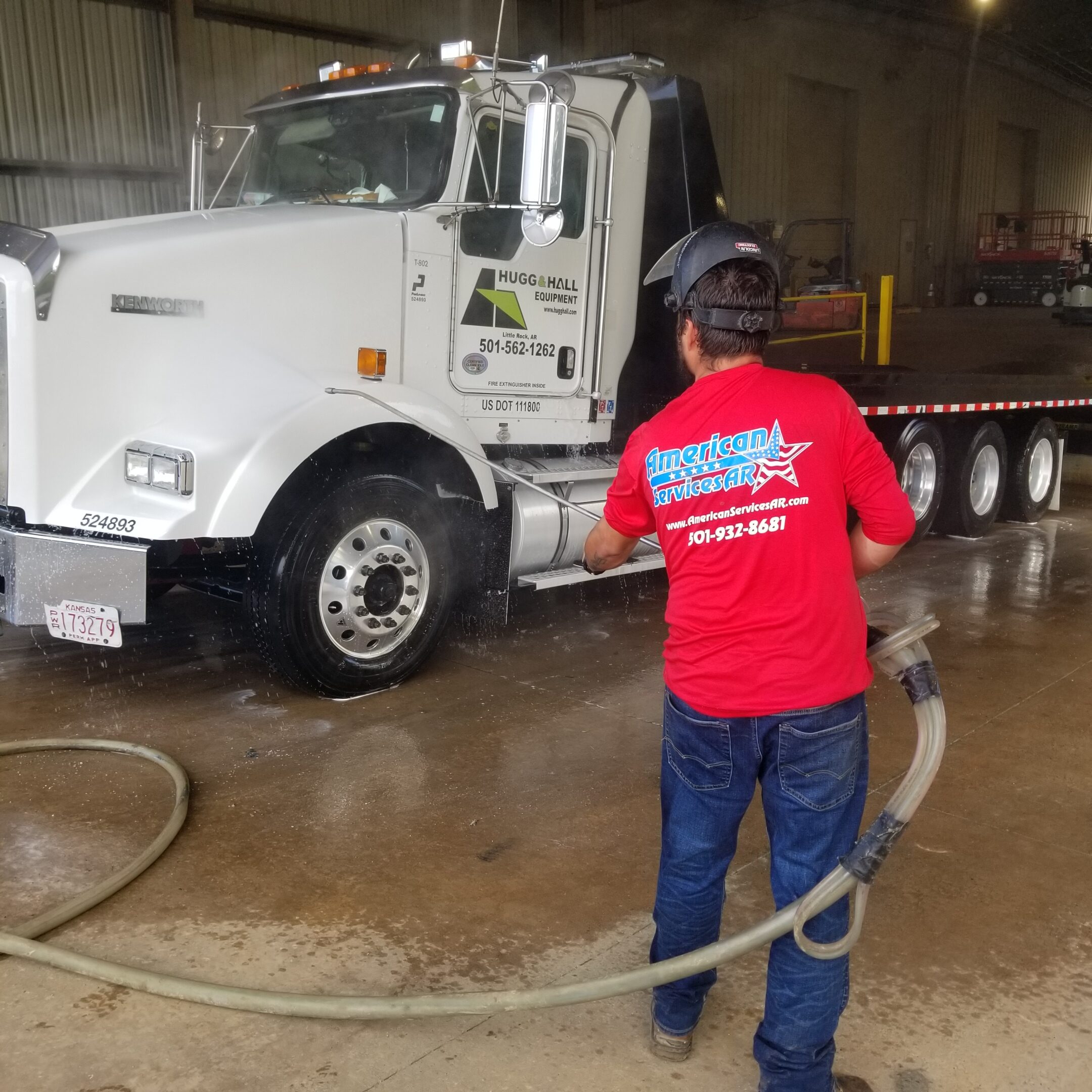
A single detergent cannot lift both acidic and alkaline soils, so heavy fleet work uses two chemistries in sequence. A low-pH first step breaks the mineral and ferrous component and brightens aluminum; a high-pH second step lifts the oils, soot and organic film. Each is rinsed, and the interaction between them does most of the work. Done properly this is a touchless process on the painted surfaces — the chemistry releases the soil and the rinse carries it off, so nothing is being dragged across the finish.
That matters more than it sounds on an industrial fleet. Brushing a truck that has aggregate dust on it is grinding an abrasive into the paint. On a fleet that gets washed every month, that compounds into visible swirling inside a couple of years, and it is the single most common way a well-intentioned wash program wrecks a paint finish.
Where we do go hands-on is the places chemistry cannot reach on its own — wheels, steps, grille meshes, fuel tank straps and the back of a box door. Those get brushed deliberately, with the right brush, and not with the one that was just on the wheels.
Aluminum: Tanks, Wheels and Trailer Skins
Bright aluminum is the surface people care most about and the one most often ruined. Polished tanks, aluminum wheels and unpainted trailer skins oxidize, and the standard fix is an acid brightener. Used correctly it restores the finish. Used at the wrong strength, left to dry in the sun, or applied to an anodised or clear-coated surface that was never meant to see acid, it burns a permanent cloudy patch that no amount of polishing brings back.
So we identify the surface before we choose the product, we work in shade or early, and we do not let brightener dry on metal. If a wheel is clear-coated we treat it as painted. If a customer wants a mirror finish on tanks, that is polishing — a separate process, priced separately, and not something an acid wash achieves no matter how many times it is applied.
Where the Wash Water Goes
This is the part of commercial fleet washing that separates contractors, and it is worth asking anyone who quotes you. Wash water carrying oils, solids and detergent is not permitted to enter a storm drain — storm drains discharge to surface water untreated. On a North Little Rock industrial yard, the drain in the middle of the pad very often is a storm drain.
We work to contain and control: washing over a surface that drains where it is supposed to, using berms and mats where it does not, recovering water where the site requires it, and discharging to sanitary sewer where that is the approved route. Where a site has its own environmental procedure or a permit with conditions attached, we work to that document rather than to our habits, and we will ask for it before the first visit rather than after an inspection.
How a Fleet Program Runs
- We look at the yard first. Surface, slope, drainage, water source, power, lighting, gate access and where units sit. This decides almost everything about price and method, and it cannot be done over the phone.
- We agree the unit list and the standard. A tractor unit, a dump body and a service van are three different jobs and three different prices. What “clean” means also gets agreed — a wash for appearance and a wash before a DOT inspection are not the same specification.
- We set a frequency. Monthly suits most mixed industrial fleets here. Aggregate and paving work often needs service every two weeks through the working season. Anything on a customer-facing route usually wants more.
- We work when the yard is empty. Most North Little Rock fleets are out during the day, so the wash happens overnight, at weekends, or in the window between last-in and first-out. We are 27.5 miles from the yard — around a half-hour run — which makes an early start here practical rather than theoretical.
- You get a record. Units washed, date, and anything we noticed while we were against the vehicle: a weeping seal, a cracked lamp lens, a tire worth a second look. We are not inspectors, but we are the people who see every truck up close every month.
What Regular Washing Is Actually Buying You
Appearance is the obvious one, and on liveried vehicles it is worth real money — a branded truck is advertising, and a dirty one advertises something you did not intend. But the arguments that hold up on an industrial fleet are the quieter ones. Road salt and de-icer left through a winter attacks frames, brake components and electrical connectors. Aggregate dust left on aluminum etches it. Ferrous fallout left on paint becomes rust pitting. And a driver doing a pre-trip walkaround on a clean vehicle can actually see a leak, a crack or a chafe — on a gray truck, every surface looks the same until something fails.
Fleet Washing in North Little Rock, AR — Questions We Get
Do you come to our yard?
Yes — effectively all of our North Little Rock fleet work is done on the customer’s site. We bring water, power and containment as the yard requires. Taking a fleet off site to wash it costs you driver hours and vehicle availability, which is usually more than the wash.
Can you work overnight?
Overnight and weekends are normal for us here, because that is when the yard is full and the trucks are not earning. We need adequate lighting or we bring our own, and we need to know the gate and alarm arrangements in advance.
Will it damage our wraps or decals?
Not with the method above. Wrap and vinyl damage comes from pressure held too close, heat, and aggressive brushing at the edges where the vinyl is terminated. A touchless chemical wash at a sensible distance is the safest thing you can do to a wrapped vehicle, and it is why we prefer it on liveried fleets.
How often should an industrial fleet be washed?
Monthly is the baseline for mixed industrial work in this area. Every two weeks through the paving and haul season if the vehicles are on aggregate or asphalt daily. Anything carrying livery into customer sites tends to want more, and that is a marketing decision rather than a maintenance one. We will tell you what the vehicles need; the frequency above that is yours.
What about winter?
Winter is when washing matters most and gets skipped most. De-icing chemicals are aggressive on frames, air lines, connectors and brake hardware, and they keep working until they are rinsed off. We do run in cold weather, with the obvious limits around freezing surfaces and standing water on a yard.
How is it priced?
Per unit, by vehicle class, with the yard conditions and the frequency factored in — a fleet washed monthly prices differently per unit than a one-off on vehicles that have not been touched in a year, because the first visit is always the hard one. Our pricing guidance is above. For anything over a handful of units we would rather walk the yard and count them than guess from a vehicle list.
★ 4.9 Google Rating | Since 2010 | Fully Insured | Free Estimates
When your property needs professional fleet washing North Little Rock AR service, American Services AR delivers — a thriving city across the Arkansas River from the capital, including the Argenta Arts District. We provide expert fleet washing North Little Rock AR homeowners and businesses rely on, with fully insured service and free estimates throughout Pulaski County. Call (501) 289-5623 to schedule your free estimate today.
Fleet Washing North Little Rock AR — Pricing Guide
Pricing for fleet washing North Little Rock AR depends on property size, surfaces, and scope of work:
- Standard commercial vehicle (van or truck): approximately $40 to $80
- Semi truck (cab only): approximately $75 to $125
- Semi truck + trailer: approximately $120 to $200
- Volume fleet pricing: available for 5-plus vehicles per visit
We provide free, on-site estimates for every fleet washing North Little Rock AR job throughout Pulaski County. No surprise charges — we quote the complete job before we begin. Call (501) 289-5623 or request a free estimate online. We respond the same business day.
Areas We Serve
American Services AR is based in Conway and has worked across Arkansas since 2010. These are the main markets our crews cover — each link opens that city’s page.
Central Arkansas
Across Arkansas
Related Services in North Little Rock, AR
- Pressure Washing in North Little Rock, AR
- Construction Cleanup in North Little Rock
- Parking Lot in North Little Rock
- Gutter Cleaning in North Little Rock, AR
- Solar Panel Cleaning in North Little Rock
Where can I find fleet washing near me in North Little Rock, AR?
American Services AR provides professional fleet washing near you throughout North Little Rock, AR and Faulkner, Pulaski, Saline, and surrounding counties. We’re locally based in Conway — same-day and next-day appointments available. Call (501) 289-5623 or book online to schedule fleet washing near you today. Median property value in North Little Rock is around $169,500, and we scope and price from the building in front of us either way.